A simple puppy routine
A practical, easy-to-follow daily routine to help your puppy feel secure, learn faster and thrive, with potty breaks, naps, meals and short training sessions.
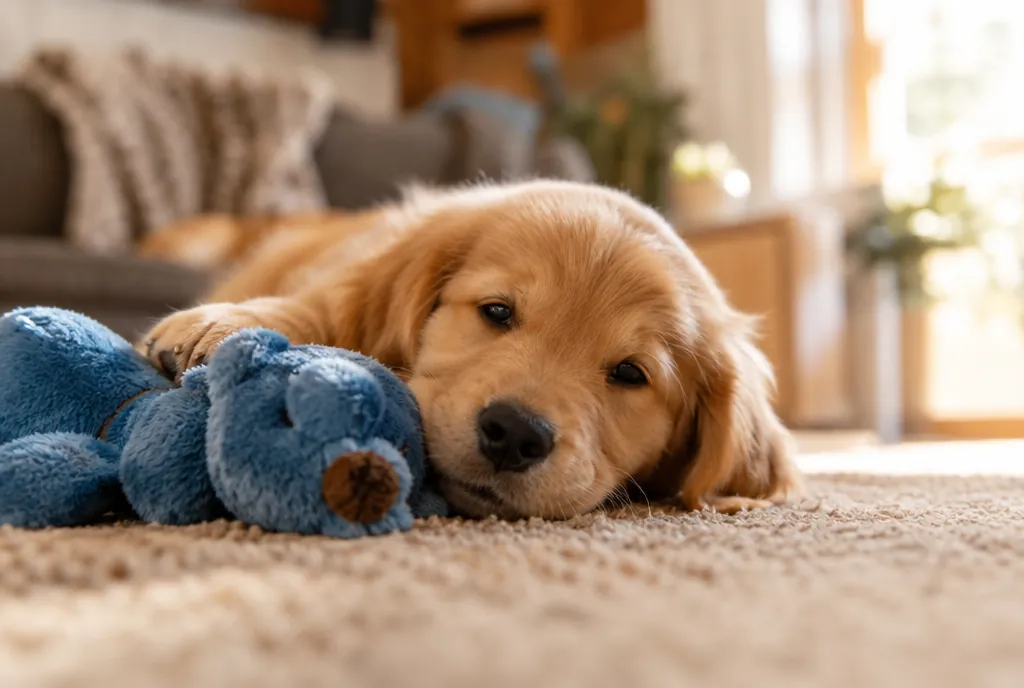
A new puppy learns fastest when each day follows a familiar rhythm. A predictable routine makes house training easier, helps your puppy settle and gives you a plan for the busy first weeks. Below is a sample day built on guidance from the American Kennel Club (AKC), VCA Animal Hospitals and Humane World for Animals. Adjust the times to your household; what matters is the order and the consistency.
The building blocks
- Potty breaks: at least every two to four hours, and after every change of activity: waking up, eating, napping, playing and before bed (AKC). Puppies usually need to go within a few minutes of eating.
- Meals: most puppies eat three meals a day (AKC). Ask your vet about amounts for your puppy's breed and age.
- Sleep: puppies sleep a lot, around 16 to 20 hours a day, often in naps of 30 minutes to two hours after play (AKC).
- Training: sessions of five to 10 minutes, always ending on a positive note (AKC). VCA recommends starting with just a few minutes, several times a day, using rewards.
A sample day
| Time | What happens |
|---|---|
| 7:00 | Wake up, straight outside for a potty break |
| 7:15 | Breakfast, then another potty break a few minutes later |
| 7:45 | Short play and a 5-minute training session |
| 8:30 | Nap in the crate or pen |
| 10:30 | Potty break, play, gentle socialization |
| 11:30 | Nap |
| 12:30 | Potty break, lunch, potty break |
| 13:00 | Calm time with a chew, then a nap |
| 15:00 | Potty break, play, short training session |
| 16:00 | Nap |
| 17:30 | Potty break, dinner, potty break |
| 18:30 | Family time and a short walk or garden play |
| 20:00 | Wind down, quiet chew |
| 21:30 | Last potty break, bed in the crate |
Expect night-time potty breaks for a while with a young puppy.
Make the crate a safe place
AKC recommends that puppies nap and sleep in a crate or pen. Humane World for Animals suggests introducing it gradually: let your puppy explore it, feed meals inside it, then build up from short stays to longer ones. Never use the crate as punishment, choose a crate big enough for your puppy to stand up and turn around in, and keep stays for puppies under six months to three or four hours at a time.
Don't skip socialization
Puppies go through a sensitive period for socialization in their first few months. The Merck Veterinary Manual describes it as roughly 3 to 12 weeks of age, and VCA describes a sensitive period from about 3 to 16 weeks. During this time, gentle, positive experiences with people, sounds, surfaces and handling help prevent fear later in life.
VCA advises not waiting until vaccinations are finished to start socializing, while avoiding dog parks and unvaccinated dogs. Puppy classes that require vaccinated, parasite-tested puppies are a good option. Ask your vet what is safe for your puppy's vaccination stage.
Tips that make the routine work
- Go out with your puppy and reward them right after they go, so they learn what the trip is for.
- Supervise or crate. Accidents happen when a puppy is unsupervised; the crate or pen covers the times you can't watch.
- Keep training short and fun. Several tiny sessions beat one long one.
- Let them sleep. An overtired puppy is often a bitey, frantic puppy. A nap after play is part of the plan.
Sources
- AKC. Setting Schedules and Developing a Routine for Your New Puppy
- AKC. How to Make Sure Your Puppy Gets Enough Sleep
- AKC. Teach Your Puppy These 5 Basic Cues
- Humane World for Animals. How to Crate Train Your Dog or Puppy
- VCA Animal Hospitals. Puppy Behavior and Training: Socialization and Fear Prevention
- VCA Animal Hospitals. Puppy Behavior and Training: Training Basics
- Merck Veterinary Manual. Social Behavior of Dogs
Frequently asked questions
How often should I take my puppy out to potty?
The AKC recommends at least every two to four hours and after every change of activity: first thing in the morning, after meals, after naps, after play and before bed.
How much do puppies sleep?
A lot. AKC guidance puts it at around 16 to 20 hours a day, often in naps that follow play.
How long should puppy training sessions be?
Short. The AKC suggests five to 10 minutes, ending on a positive note, and VCA suggests just a few minutes at first, several times a day.
How long can a puppy stay in a crate?
Humane World for Animals advises that puppies under six months shouldn't stay in a crate for more than three to four hours at a time.
Keep reading
More in Training →-
Training
How to introduce a cat and a dog
A calm, step-by-step plan for introducing a cat and a dog: separate spaces, scent swapping, barrier and leashed meetings, and the stress signs that mean slow down.
-
Care
How to brush your dog's teeth
A step-by-step plan to get your dog used to tooth brushing, how often to do it, which toothpaste is safe, and how to spot products with the VOHC seal.
-
Care
Heatstroke in dogs: signs and first aid
How to recognise heatstroke in dogs, which dogs are most at risk, why exercise causes more cases than hot cars, and the 'cool first, transport second' first aid that can save a life.